The Book
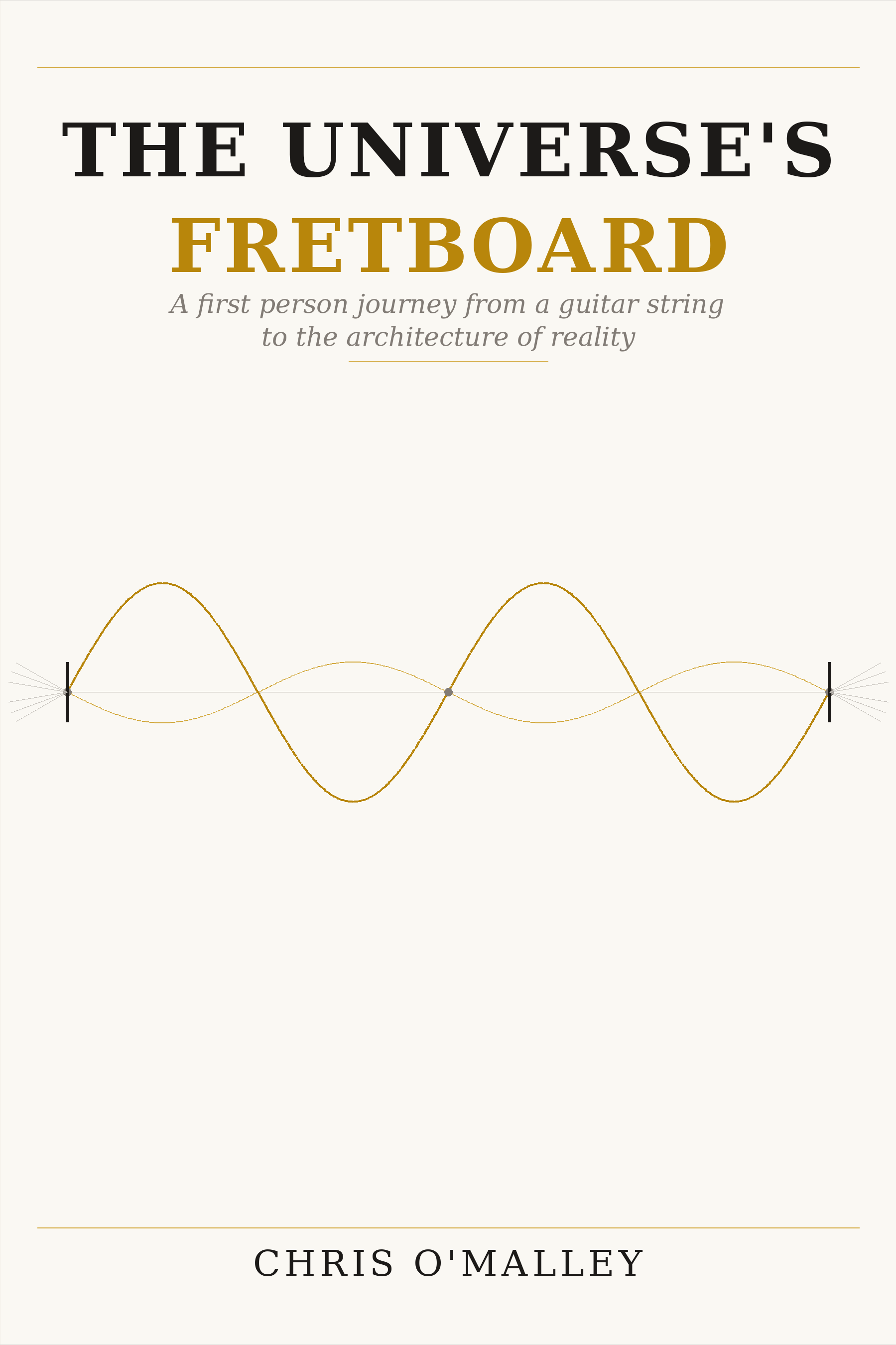
From a guitar string
to the architecture
of reality
It began with an article about quantum physicists exploring whether information might travel backwards through time. That single question led, step by step, to a framework connecting the deepest puzzles in physics to the oldest practices in human contemplative tradition.
The universe's fundamental constants — the twenty-six numbers that determine everything from the strength of electromagnetism to the mass of the electron — are not arbitrary. They are the fret positions of an instrument whose geometry determines every permitted harmony.
Every reference is verified. Every speculation is clearly labelled. The science is real. The framework is original.
I
The Standing Wave — retrocausality and the block universe
II
The Fretboard Is Real — from the ultraviolet catastrophe to the fine structure constant
III
The Chord — four forces, one instrument, brane cosmology
IV
The Instrument — Kaluza-Klein, the holographic principle, the bulk
V
The Speed of the Music — what the speed of light actually is
VI
The Full Spectrum — dark matter, dark energy, the Higgs, and consciousness
VII
The Receiver — Libet, Orch-OR, and the brain as quantum antenna
VIII
The Transmitter — coherence, intention, and contemplative tradition
IX
Interference and Resonance — what is evidenced, what is contested
X
The Player and the Instrument — the full architecture, stated whole